
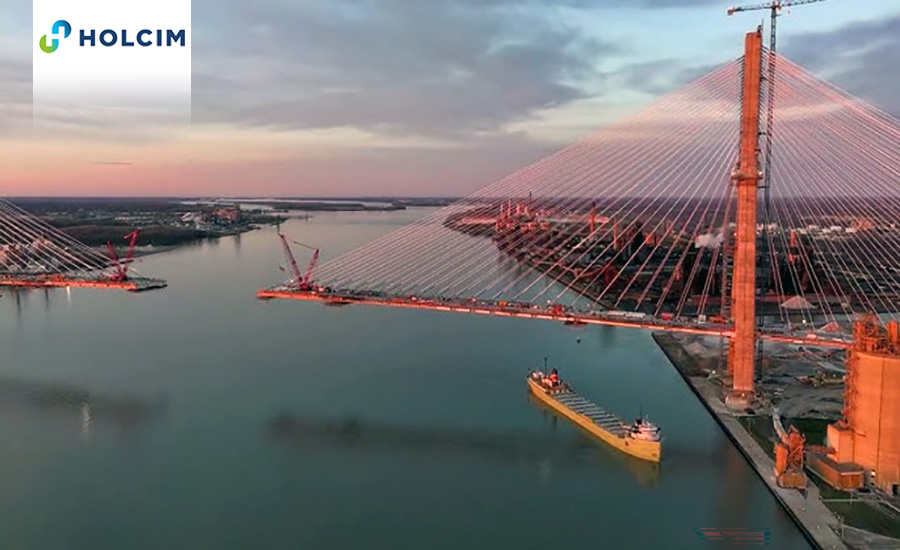
Holcim and Detroit’s Port Authority Win Grant to Improve Air Quality
Holcim and Detroit’s Port Authority Win Grant to Improve Air Quality
November 6, 2024

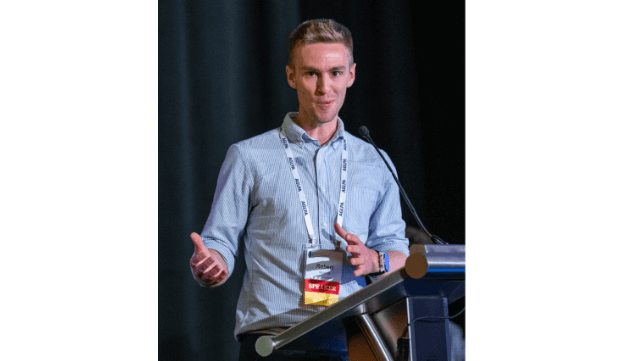
Tunley Environmental Helps Port of Detroit in Clean Ports Funding
Tunley Environmental Helps Port of Detroit in Clean Ports Funding
Robert Moorcroft - Tunley
Bold plan to decarbonize Detroit port operations, improve air quality and residents’ health
Bold plan to decarbonize Detroit port operations, improve air quality and residents’ health
Release date: Earth Day, April 22, 2024
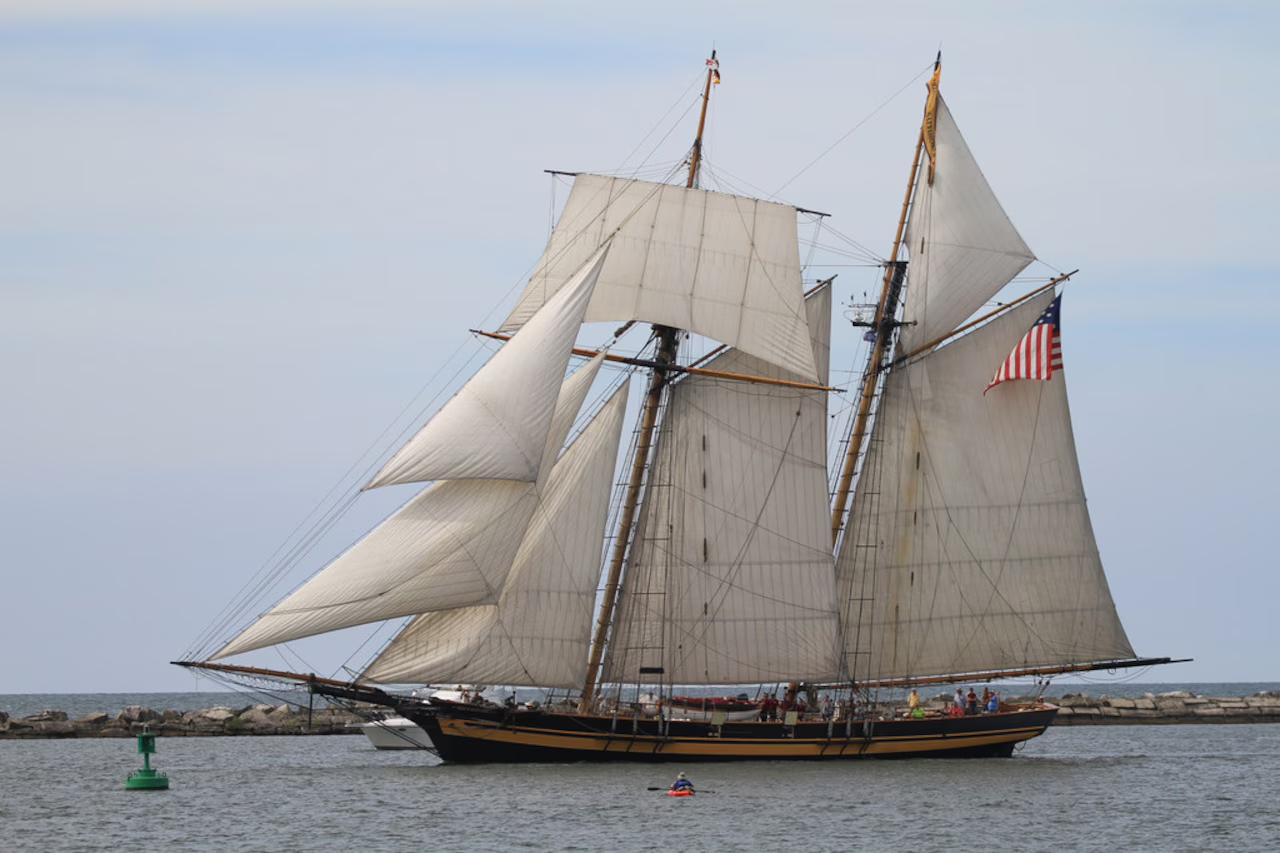
The Detroit riverfront will soon be filled with numerous Tall Ships
“There are so many lessons that can be taught with these ships,” said Mark Schrupp, Executive Director, Port Authority. “Our guests will learn about maritime careers, history, sustainability and Detroit as an important port when they come down to see the Ships.”
The Tall Ships will arrive on August 7, traveling along the Riverfront, before docking for three days of public access. Ticket holders will be able to board the Tall Ships, meet the crews and learn about the rich sailing history of the Great Lakes. There is also a special ticket available for purchase which allows guests to set sail aboard the Alliance for a 90-minute cruise.
Along with Detroit, the Tall Ships will make stops at Duluth, MN and Erie, PA, among other ports this summer.
Detroit/Wayne County Port Authority Seeks Decarbonization
Detroit/Wayne County Port Authority Seeks Decarbonization
Kim Kisner | Business | 08/08/2023
Michigan’s largest inland port, the Port of Detroit is located on the Detroit River in Wayne County as well as the navigable portions of the Rouge River. The Detroit/Wayne County Port Authority oversees the port, which is made up of multiple marine terminals for handling general, liquid, and bulk cargo as well as passengers.
Each year, the Port Authority oversees more than eight million tons of cargo at 29 private and public sector terminal facilities in the Port of Detroit, including international and domestic commodities, which are shipped in and out of the port. The port is the third-largest steel-handling port in the nation. At the Port Authority’s own terminal, steel, aluminum, and project cargoes are handled for the support of the manufacturing community in Southeast Michigan.
Now, the port is undergoing a decarbonization project which aims to reduce its environmental impact and improve air quality.
The decarbonization project will be undertaken in partnership with Tunley Engineering and Southwest Detroit Environmental Vision (SDEV) and will involve a range of initiatives, including the implementation of renewable energy sources, the electrification of port equipment, and the use of cleaner fuels while ensuring residents and businesses in the area are involved and have input.
Said Raquel Garcia, executive director of SDEV, “We are on board to – among other things – make sure the community understands what’s happening in their own backyard and that they have access to people leading the project.”
SBN Detroit spoke with the executive director of the port, Mark Schrupp, about the project and its impact on tourism, area businesses, and more.

Q: The Port of Detroit is going green with the goal of net zero by 2040. Can you provide some background on how you arrived here and how you are taking this on?
A: Discussions originated in early 2022 with the Great Lakes St. Lawrence Governors & Premiers, looking at ways to help decarbonize the maritime industry. Our two overarching goals are to improve air quality and reduce greenhouse gas emissions.
A lot of the ports on the West Coast and Europe have been doing good work for several years. The Midwest is a little behind but starting to accelerate.
We reached out to state Sen. Stephanie Chang, and she has been a great supporter. She assisted in helping us to secure $1 million in state funding to undertake a study on where we are today and develop a plan to decarbonize.
The big challenge is that the Port Authority does not have the authority to compel the private terminals, which are responsible for 95% of the cargo, to participate. We have been identifying incentives and working to persuade these terminals to develop a single plan, measure the greenhouse gas emissions, and develop strategies together.
To start, we needed outside expertise. We put together a scope of work in December and put out an RFP and ended up partnering with Tunley Engineering, which has been eager to jump in and help. We have also been working heavily with Southwest Detroit Environmental Vision (SDEV) who – among other things – is helping us to connect to the community to ensure we understand what their interests are.
You can’t take on just a decarbonization plan… in the port region where people work and live it’s also about air quality, vibrations, sound and particulate matter, and more. So, we are looking at these things and working to address them through best practices.
Since April, we’ve been engaging with terminals to get a baseline report of greenhouse gas emissions for each terminal. Once finished, we will publish an interactive map for people to see the current carbon footprint.
We are specifically looking at the carbon footprint of moving cargo in and off the water – not the industrial practices of the businesses. We are also looking at the cruise ships that we service at our downtown dock, and the impacts and the footprint of governmental entities that participate in the port, such as the Detroit Police Harbor Master, U.S. Army Corps of Engineers, and more.
This is a good time to be taking all of this on. There is a lot of federal and state funding and tax incentives that help bring down the initial cost of switching fuel sources. We’ll be applying for grants to help the terminals move forward.
Q: What other entities are you working with to take on this project?
A: We are engaging with many organizations and local sustainability offices to help and support our efforts.
We have been working with The Department of Environment, Great Lakes, and Energy (EGLE) to get data and take advantage of any grant opportunities to tackle air quality and particulate emissions.
We have met with the EPA Region 5 office in Chicago to stay close in terms of funding opportunities and ways they can support our efforts.
The International Maritime Organization has a 2050 plan in place and is setting standards around the fuel in the ships that move in international waterways. They are looking at cleaner fuel alternatives as well.
The Port has a fueling station run by Waterfront Petroleum, and they are working toward a biodiesel fuel that can be used without having to change engines.
Maritime infrastructure is very expensive and lasts a long time, so making changes needs to be planned carefully. Changing fuel to a lower carbon footprint, like biodiesel is a good first step because it doesn’t require any changes to ship engines. Zero-carbon fuels like hydrogen and ammonia will take more planning and investment. We can’t do it all at once but should do what we can as we work in the right direction.
Q: Do you think this a unique undertaking for a port authority?
A: Ports on the coasts have been working on this for some time. California has led the way and those ports are ahead of us. The Port of Cleveland has done work to reduce its carbon footprint. So, they are a little ahead of us, but the rest of the ports in the Great Lakes have started work here.
Q: How do you think your efforts will impact tourism in Detroit?
A: We know that tourists are becoming more aware of environmental issues and concerns and that can impact decisions to travel. The cruise industry itself has made some commitments to decarbonize.
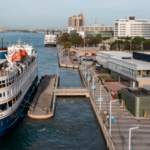
One of the things we are working to develop is getting shore power for our cruise dock so that when they dock, they can turn off their engines and run on electricity.
We are seeing a lot of things happen at the state level. The governor signed a pact with Canada to create an EV corridor so electric charging can happen, which I think will increase tourism back and forth between the U.S. and Canada. The auto companies are heading toward 100% EV. The greener we can make our port and our state the more that can be used to encourage tourism.
Q: How do you think your efforts will impact Southeast Michigan businesses?
A: I think we can be an example for businesses and encourage the businesses around us who need to move in this direction. There is a school of thought that going green can be expensive and hurt the bottom line. We are hoping to demonstrate that this is not the case. We are working to also highlight the businesses on the waterfront that are doing it and are still profitable. I think this will create momentum.
If Detroit wants to be in the game for shipping and getting cargo to come through our terminals, we need to green up. It is going to be essential to be considered part of the international community for shipping.
Q: What about job creation as it relates to this project?
A: There is an economic impact study just released that talks about jobs and economic activity related to maritime work. We’ve been promoting maritime activity as a job creator for some time. The whole region owes its economic activity to the fact that we are on the Detroit River. Iron ore can be shipped in, and we can make steel and manufacture cars. Where we are located has been a part of our existence as an economy.
And if we continue to produce gas-powered cars and not decarbonize, eventually we will be out of business. The Big Three are leading the way. And the Port needs to be a part of it.
The state of Michigan is investing in jobs created in the green sector and I think this is happening in and impacts many industries, including the maritime industry.
We are looking at repurposing some of the former industrial plants and increasing the manufacturing along the waterfront to further strengthen Michigan as a hub for manufacturing and the movement of goods. We are on an international border; we have a great rail system and a great highway system which makes it a great spot for this area to generate jobs.
Q: Talk about the innovative sustainable approaches you are using.
A: We are looking at every aspect of fuel generation. Electrification, solar, wind, biofuels, etc. We are looking at different ways to move goods – innovative ways may include putting sails on boats and using wind. We are also working to use the waterways for finished goods and parts, not just for raw materials.
With the Ford Mobility Center here in our backyard now working toward innovation in mobility as well, it’s a great time to be thinking about how we can transform how we get things done.